AI Transformation Is a Problem of Governance: 5 Critical Fixes
Your AI transformation isn’t failing because you chose the wrong model, it’s failing because you ignored governance. According to Deloitte’s 2026 AI report, nearly 74% of companies plan to deploy agentic AI within two years, yet only 21% have mature governance frameworks. That 53-point gap represents billions in wasted investment, and the companies winning at AI solved governance first.
What Is AI Governance and Why Does It Define Transformation Success?
AI governance extends far beyond compliance checklists or ethics committees meeting quarterly. Real governance means establishing clear decision rights, accountability structures, and operational guardrails before autonomous systems touch your business processes.
Traditional IT governance assumed software behaves predictably. Your CRM works the same way every Tuesday. AI systems operate probabilistically, outputs shift based on data consumed, and yesterday’s results might differ entirely tomorrow.
This fundamental difference explains why organizations treating AI like traditional software implementations have struggled. You cannot govern a learning system with static policies designed for deterministic tools.
Effective AI governance requires three interconnected layers:
- Strategic oversight determining which problems AI should solve
- Operational controls defining how AI outputs get validated before action
- Technical monitoring ensuring model behavior stays within acceptable boundaries
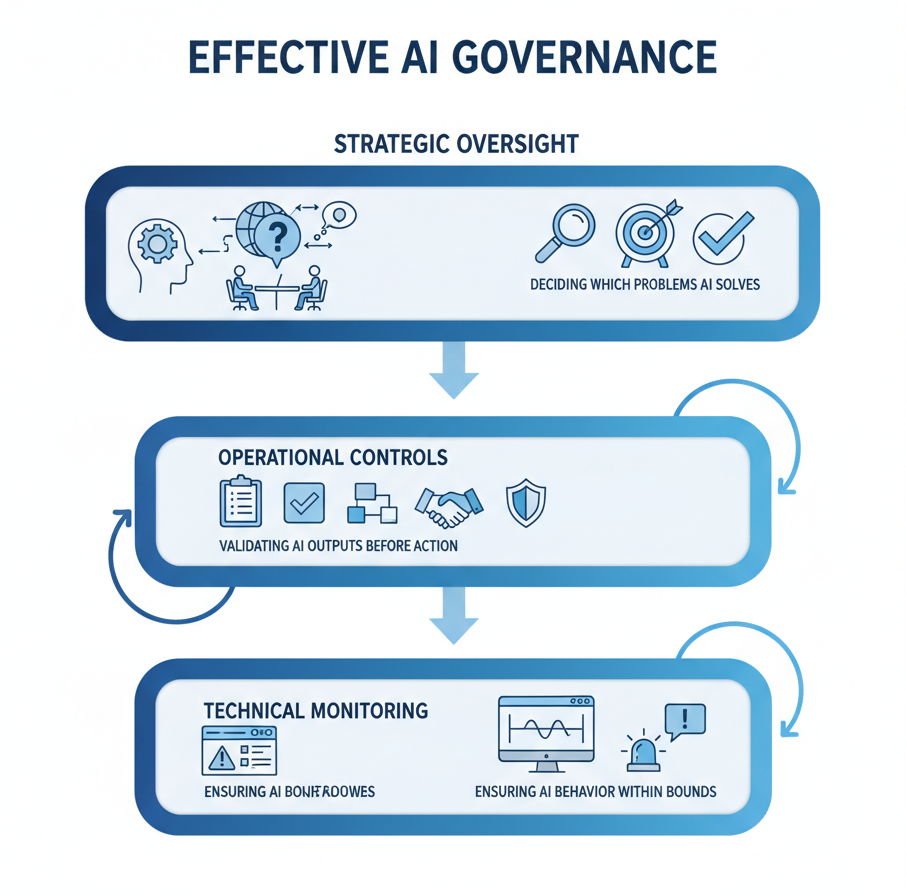
Most organizations have fragments of one layer but nothing resembling an integrated framework.
The LSE and Protiviti 2025 study found AI saves knowledge workers an average of 7.5 hours weekly, with trained employees saving up to 11 hours. Those gains evaporate when ungoverned AI produces outputs requiring extensive human correction or causes damage nobody catches until customers complain.
The AI Transformation Playbook Most Companies Are Missing
Every AI transformation playbook circulating in boardrooms focuses on use case identification, vendor selection, and pilot execution. These guides treat governance as a compliance checkbox near the end, something legal reviews after deployment decisions are made.
This sequencing is backward.
| Governance Stage | Traditional Approach | Effective Approach |
|---|---|---|
| Use Case Selection | Business value only | Value + risk + oversight feasibility |
| Pilot Design | Technical proof-of-concept | Governance model validation |
| Scaling Criteria | Performance metrics | Control mechanisms transfer |
| Ongoing Operations | Annual audits | Continuous monitoring and adaptation |
Organizations succeeding at AI transformation embed governance into use case selection from day one. They ask not just “Can AI do this?” but “Can we govern AI doing this at scale?”
On April 6, 2026, OpenAI released a policy document titled “Industrial Policy for the Intelligence Age.” Even companies building these systems acknowledge that capability without governance creates risk. Your organization faces the same dynamic at enterprise scale.
Why AI Governance Principles Must Precede AI Strategy
Most discussions about AI governance principles position them as ethical guardrails constraining what AI can do. That framing misses the point entirely.
Strong governance principles actually expand what AI can do by creating organizational confidence necessary for aggressive deployment. When leadership trusts oversight mechanisms, they approve higher-stakes applications. When employees understand accountability structures, they integrate AI into workflows rather than working around it.
Four principles matter most:
Explainability means humans can understand why AI produced specific outputs. Without explainability, you cannot debug problems, satisfy regulators, or build user trust.
Accountability assigns clear ownership for AI outcomes to specific humans. The machine didn’t make that decision. Someone authorized the machine to make decisions within certain parameters.
Contestability gives affected parties meaningful appeal mechanisms. Customers denied credit and employees flagged by performance systems need paths to human review.
Adaptability recognizes that governance frameworks must evolve as AI capabilities mature. Rules sufficient today won’t work in eighteen months.
AI Transformations Fail at Scale Because Governance Doesn’t Transfer
Pilots succeed constantly. Scale deployments fail constantly. The gap isn’t technical, it’s governmental.
During pilots, small teams provide intensive oversight. Senior stakeholders review outputs personally. Edge cases get handled through ad-hoc escalation. This artisanal governance works beautifully for limited applications but cannot scale to enterprise-wide deployment.
McKinsey research indicates task automation can reduce working time on repetitive activities significantly for knowledge workers. Capturing those gains requires governance structures working across thousands of users, dozens of departments, and hundreds of interconnected processes, not heroic individual oversight.
Organizations that scale successfully invest disproportionately in governance transfer mechanisms:
- Documented escalation procedures
- Automated monitoring dashboards
- Clear role definitions
- Training programs extending oversight capabilities beyond pilot teams
According to Layoffs.fyi, tens of thousands of tech workers were laid off from January through early April 2026, with a substantial portion attributed to AI automation. Companies making workforce decisions based on AI outputs carry extraordinary governance obligations.
What AI Governance Looks Like When It Actually Works
Abstract governance discussions become concrete when examining organizations deploying AI successfully at scale.
Successful governance isn’t about preventing AI use, it’s about enabling responsible use while maintaining clear accountability. Research on workplace transformation, including Microsoft Japan’s four-day workweek study reporting significant productivity increases, demonstrates that ambitious changes succeed when governance structures support rather than impede progress.
A 2024 UK four-day workweek trial involving 61 companies showed 92% continued shortened weeks after pilots ended. These organizations proved that ambitious workforce transformation succeeds with proper governance. AI transformation requires the same lesson.
Effective governance structures include:
| Component | Function | Frequency |
|---|---|---|
| AI Steering Committee | Cross-functional oversight | Monthly meetings |
| Model Registry | Document all deployed systems | Continuous updates |
| Decision Logs | Capture AI-influenced choices | Real-time logging |
| Incident Response | Handle AI failures | As needed with quarterly drills |
| Recertification | Ensure human competence | Quarterly assessments |
The Hidden Governance Gap: Third-Party AI Tools Your Employees Already Use
Most governance discussions focus on AI systems companies deliberately deploy. This misses a massive blind spot: the AI tools employees already use without organizational awareness or approval.
Research suggests knowledge workers increasingly use personal AI assistants, browser extensions, and productivity tools containing AI components. These shadow AI deployments create governance exposure most organizations haven’t addressed.
Effective governance must inventory not just official AI deployments but also establish policies for employee-introduced AI tools. Questions to address include:
- What data can employees input into personal AI tools?
- How do you detect unauthorized AI usage on company systems?
- What training helps employees understand risks of shadow AI?
Organizations solving this shadow AI governance challenge gain competitive advantage through broader AI adoption while maintaining control.
The Argument That AI Will Change Everything Misses the Point
Yes, AI will change everything. That observation tells you nothing useful about what to do next.
The relevant question isn’t whether AI will transform your industry. The relevant question is whether your organization will capture transformation value or become a cautionary case study in ungoverned deployment.
Companies treating AI as primarily a technology problem build increasingly sophisticated tools while governance debt compounds. Eventually, regulatory action, public incidents, or competitive failure forces a reckoning.
Companies treating AI transformation as a problem of governance from the beginning move slower initially but scale faster. They avoid pilot-to-scale transition failures consuming enormous resources.
The choice isn’t between governance and speed. It’s between governance now and mandatory governance later, at far higher cost.
Frequently Asked Questions
What is AI governance and how does it differ from regular IT governance?
AI governance encompasses policies, processes, and organizational structures ensuring AI systems operate within defined boundaries while remaining accountable to human oversight. Unlike traditional IT governance designed for deterministic software, AI governance accommodates probabilistic outputs and learning behaviors where systems may produce different results from identical inputs over time, requiring continuous monitoring rather than periodic audits alone.
Why do so many AI transformation initiatives fail despite significant technology investments?
Most AI failures stem from governance gaps rather than technical limitations. According to Deloitte’s 2026 report, while 74% of companies plan agentic AI deployment within two years, only 21% have mature governance frameworks. This creates a massive gap between technological capability and organizational readiness, meaning even technically excellent implementations struggle to deliver sustained business value without proper oversight structures.
What should be included in an effective AI transformation playbook?
An effective AI transformation playbook prioritizes governance framework development before technology selection. Include use case evaluation criteria considering oversight feasibility alongside business value, governance model validation during pilot phases, control mechanism transfer requirements for scaling, and continuous monitoring protocols for ongoing operations. Treat governance as foundational infrastructure rather than a compliance checkbox added near deployment completion.
How do AI governance principles translate into practical operational requirements?
AI governance principles become operational through specific mechanisms. Explainability requires documentation standards surfacing decision rationales. Accountability requires explicit role definitions and decision logging. Contestability requires appeal processes and human review pathways. Adaptability requires scheduled framework reviews and change management procedures. Without these concrete implementations, principles remain aspirational statements rather than organizational capabilities driving real accountability.
Q: What governance structures do successful AI deployments typically include?
Successful deployments include AI steering committees with cross-functional representation meeting monthly, comprehensive model registries documenting all deployed systems with clear ownership, decision logs capturing AI-influenced choices for audit purposes, incident response protocols designed specifically for AI failures, and regular recertification requirements ensuring human overseers maintain competence to supervise increasingly sophisticated systems effectively.
How should organizations balance AI governance requirements with competitive pressure to deploy quickly?
Organizations should recognize that governance enables rather than impedes sustainable competitive advantage. Companies deploying AI without adequate governance frequently experience pilot-to-scale transition failures ultimately slowing progress. Investing in governance upfront typically accelerates time-to-value at scale even if modestly slowing initial deployment. The real choice isn’t governance versus speed—it’s building governance now or rebuilding later at significantly higher cost.
Q: What role should boards and executive leadership play in AI governance?
Boards and executives must treat AI governance as strategic priority rather than delegating entirely to technical teams. Deloitte’s research shows AI appears more frequently on board agendas, but many respondents report their boards have limited AI expertise. Leadership must develop sufficient understanding for meaningful oversight while establishing clear accountability connecting AI outcomes to existing corporate governance structures and fiduciary responsibilities.
Q: How do workforce implications factor into AI governance frameworks?
Workforce implications represent a critical governance dimension requiring careful attention. Organizations making workforce decisions based on AI outputs have heightened governance obligations ensuring those systems operate fairly and affected employees have appropriate appeal mechanisms. Governance frameworks must address both operational efficiency and human dimensions of deployment, including transparency about how AI influences hiring, performance evaluation, and workforce planning decisions.
Conclusion
Stop treating AI transformation as technology procurement. This week, audit your current AI initiatives against one question: who owns outcomes when AI produces unexpected results? If you cannot answer clearly, your governance gap already creates invisible risk.