AI Contextual Organizational Knowledge: The Validation Framework Most Enterprises Skip
A practitioner’s guide to making AI actually understand how your business works, why most implementations fail in production, and the validation architecture that separates the few successes from the many disappointments.
What’s Wrong With How Most Companies Approach This
Most AI deployments inside enterprises in 2026 share a quiet failure pattern. The system works in the demo. It works on the test queries the leadership team picks. Then it ships, real employees start using it on real work, and the wheels come off within weeks.
The problem isn’t model quality. The frontier models from OpenAI, Anthropic, and Google all perform at roughly the same level on generic benchmarks. The problem is that generic is exactly what they remain after deployment. They don’t understand your company’s pricing exceptions, your three-legged approval workflow for capital expenditures, your unwritten rule that the Singapore office handles APAC escalations differently than Sydney, or that “Q4 close” at your firm means something different than the textbook definition.
This is the gap AI contextual organizational knowledge is supposed to fill. The term covers the layer of business-specific meaning, process, terminology, and judgment that an AI system needs in order to behave like a competent colleague rather than a confident stranger. And almost every implementation underestimates how hard that layer is to build, validate, and maintain.
This article is for IT leaders, knowledge management teams, AI program owners, and operations executives who are either planning a deployment or trying to figure out why an existing one isn’t working. It walks through what AI contextual organizational knowledge actually is, why most validation approaches fail, and the seven-part framework that separates working systems from expensive demos.
What AI Contextual Organizational Knowledge Actually Means
The phrase gets used loosely. Worth being precise.
Contextual organizational knowledge is the body of meaning that lets an AI system answer business questions the way an experienced employee would, not the way a search engine would. It includes:
Explicit knowledge, the documented procedures, policies, product specs, and internal wikis. This is the easy layer.
Tacit knowledge, the judgment calls and unwritten rules experienced staff carry in their heads. The procurement manager who knows that POs over a certain threshold need a courtesy call to finance before submission, even though no policy says so. This is the layer that walks out the door when senior staff leave.
Relational knowledge, the way different parts of the organization actually connect. Which team owns what process, which decisions need cross-functional sign-off, which exceptions are tolerated and which aren’t. Org charts capture maybe 20 percent of this.
Temporal knowledge, the way information ages. Last year’s pricing model isn’t current. The post-merger brand guidelines supersede the pre-merger ones. The compliance memo from March overrode the one from January. AI systems that ignore time generate confidently outdated answers.
A retrieval-augmented generation (RAG) system that pulls the right document is not the same as a system that understands which document is the right one for this question, this user, this moment. The second is contextual. The first is plumbing.
Why Validation Is the Layer That Decides Everything
Here’s the operational truth almost nobody puts in their RFP: AI systems are equally confident when they’re right and when they’re wrong. A well-deployed enterprise model will explain a wrong answer with the same fluency as a correct one. Without validation, you can’t tell which is which until a downstream decision goes sideways.
Three layers of validation matter, and most organizations build only the first one (badly).
Source Validation: Where Did This Come From, Is It Current?
Most retrieval systems pull whatever ranks highest on similarity. They don’t distinguish between the procurement policy from 2019 and the updated version from this March. They don’t know that the customer success playbook was authored by a team that’s since been reorganized. They don’t flag when two source documents directly contradict each other.
Source validation requires document-level metadata: authorship, last review date, supersession relationships, and authority level. Without it, your AI is averaging across versions of the truth.
Context Validation: Does This Knowledge Apply Here?
A pricing exception that applies to enterprise customers in North America does not apply to mid-market customers in EMEA. A compensation policy for full-time employees does not govern contractor agreements. A pre-acquisition workflow does not bind the newly integrated subsidiary.
Context validation is where most implementations break in subtle, expensive ways. The system retrieves accurate information and applies it to the wrong situation. The output is technically grounded in real company documents, which makes the error harder to catch on review.
Inference Validation: Does the Synthesis Actually Reflect How We Operate?
When AI combines multiple sources into a recommendation, the synthesis itself can be wrong even if every individual source is correct. The model stitches together a plausible-sounding answer that no experienced employee would actually give. This is the failure mode senior staff catch immediately and junior staff don’t, which means the systems most often deployed to support junior staff are exactly the ones with the weakest internal validation.
These three layers are the actual moat. Companies that build them deploy AI that gets better over time. Companies that skip them deploy AI that produces a steady volume of small, hard-to-detect errors.
The Seven-Part Framework for Building Systems That Actually Work
This is the operational sequence that separates working enterprise AI from demo-grade deployments. None of these steps are optional, though they can run in parallel.
Step 1: Map Tacit Knowledge Before Encoding Anything
Before you index a single document, sit with your highest-performing employees and document what they actually know. Not what’s in the policy. What’s in their head. Which exceptions exist. Which judgment calls they make weekly that aren’t written anywhere.
This is uncomfortable work. It’s also where the real organizational knowledge lives. If you skip it, your AI will only know what your worst-performing employees know, because that’s what’s documented.
Step 2: Build Validation Hierarchies Tied to Decision Stakes
Not every AI output needs the same level of review. Customer service auto-suggestions can be spot-checked. Marketing copy drafts can be edited by humans before publishing. Strategic recommendations need expert review. Financial outputs need audit-level validation.
The mistake is applying uniform validation, either too light (everywhere fails eventually) or too heavy (the system becomes useless because nothing ships). Tier the validation to the consequence of being wrong.
Step 3: Create Feedback Loops That Compound
Every validation decision, every correction, every “this is wrong” override, is training data. Capture it. Most systems don’t, which means the same mistakes recur indefinitely.
A working feedback loop logs the original output, the correction, the corrector, and the reasoning. Over six months, this dataset becomes more valuable than the underlying model.
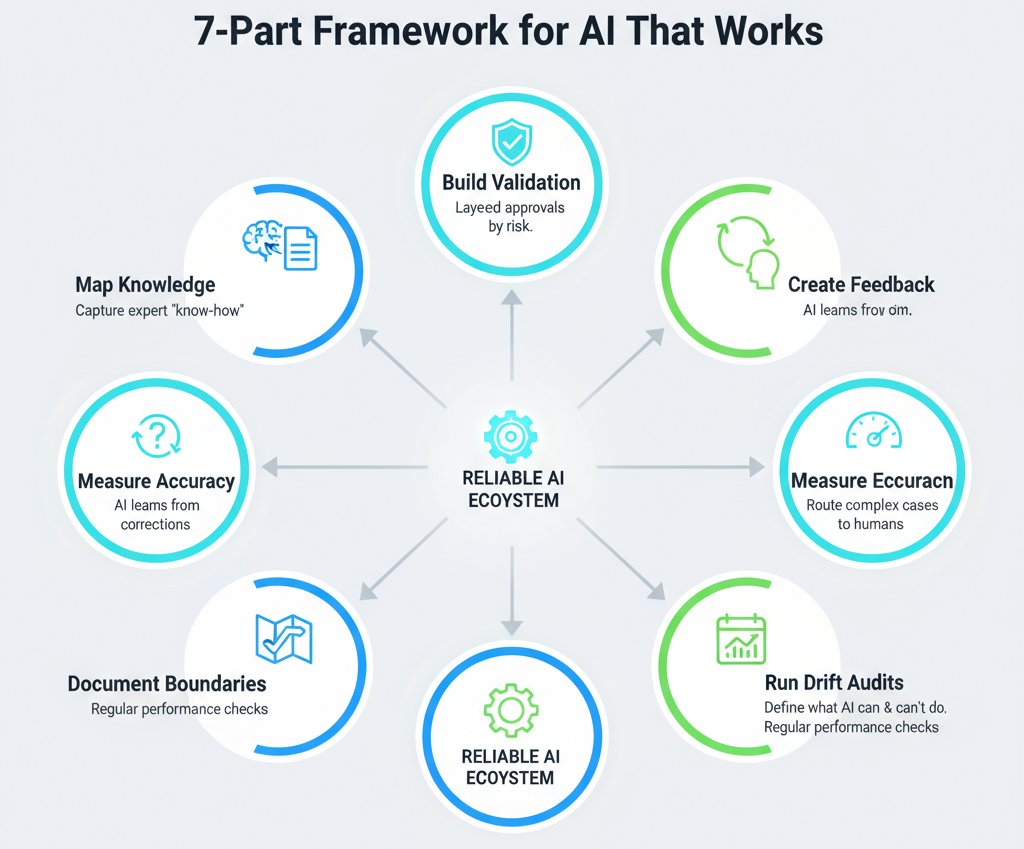
Step 4: Measure Accuracy, Not Just Speed
The most common metric leadership asks for is “how much time did this save.” That’s the wrong primary metric. The right one is “what percentage of AI outputs required correction” tracked over time, by use case, by department.
A system saving an hour per task while requiring correction 40 percent of the time is a liability dressed as productivity. A system saving 20 minutes per task with a 5 percent correction rate is a real asset.
Step 5: Engineer Explicit Escalation Pathways
AI systems should know what they don’t know. When confidence is low, when the question crosses jurisdictional lines, when the underlying sources disagree, the system should route to a human rather than generate a plausible answer.
This requires confidence thresholds, ambiguity detection, and named human escalation paths for each domain. Most off-the-shelf deployments lack all three.
Step 6: Document Context Boundaries Explicitly
Where does the AI’s knowledge apply, and where does it stop? Geographic limits, business unit limits, regulatory limits, time-sensitive limits. If these aren’t documented, the system will quietly cross them.
A simple version of this is a context boundary registry: a maintained list of which knowledge domains the AI is authorized to answer on, with explicit out-of-scope flags.
Step 7: Run Quarterly Drift Audits
Organizations change. Policies update. Personnel turn over. Products evolve. AI systems that learned the organization six months ago are working from a stale model of it.
A drift audit tests the AI on a battery of known-correct questions whose answers have changed since the last audit. Drift rate becomes a leading indicator of when retraining or re-indexing is needed.
The Real Cost of Skipping Validation
The organizations that struggle with AI in 2026 aren’t the ones that adopted slowly. They’re the ones that adopted enthusiastically without building the validation layer underneath. Their patterns are recognizable:
The customer support AI that quotes outdated return policies until enough customers complain. The sales assistant that recommends pricing tiers no longer offered. The HR chatbot that explains benefits from the previous plan year. The legal AI that cites superseded case law because the document store wasn’t refreshed.
Each individual error feels small. The aggregate is reputational risk, regulatory exposure, and a slow erosion of trust in the system that eventually leads to abandonment, which is the worst possible outcome because the underlying technology actually works when validated correctly.
The validation framework isn’t overhead. It’s the difference between AI that compounds value and AI that compounds liability.
Why Smaller Organizations Often Win at This
Counterintuitively, smaller and mid-sized companies often deploy contextual AI more successfully than large enterprises. Three reasons.
Less knowledge fragmentation. A 50-person company has fewer document silos, fewer contradictory policies, and fewer edge cases. The AI’s contextual model is simpler because the organization is simpler.
Clearer decision patterns. When the same handful of leaders make most decisions, the AI has a more consistent signal to learn from. Large enterprises have thousands of micro-decisions made in inconsistent ways, which is much harder to train against.
Faster validation cycles. Small organizations can build feedback loops in weeks. Large ones spend months on the governance committee that designs the feedback loop.
For organizations under 200 people considering AI knowledge systems: your size is an advantage if you treat it as one. Skip the enterprise-grade governance theater. Build the lightweight validation framework. Iterate.
Frequently Asked Questions
How is AI contextual organizational knowledge different from a knowledge base or wiki?
A wiki stores documents. AI contextual organizational knowledge enables a system to understand which document applies, when, to whom, and how it relates to other documents and decisions. Wikis are static repositories. Contextual systems are interpretive.
What’s the most common reason these implementations fail?
Skipping the validation layer. Companies invest in retrieval and generation but not in source validation, context validation, or inference validation. The result is a system that produces plausible but unreliable outputs at scale.
How long does it take to build a working contextual AI system?
Initial deployment usually takes three to six months. Reaching genuinely mature contextual understanding, where the system handles edge cases and learns from corrections, typically takes 12 to 18 months of continuous refinement.
Can off-the-shelf tools like ChatGPT Enterprise or Microsoft Copilot deliver this?
Partially. They handle the model and basic retrieval. They don’t handle the deep organizational context, validation hierarchies, or feedback loops. These have to be built around the tool, not bought with it.
What’s the role of knowledge graphs in this stack?
Knowledge graphs are useful infrastructure for representing relationships between entities, processes, and policies. They’re not a complete solution. Without validation frameworks layered on top, a knowledge graph just gives the AI a more structured way to be wrong.
Who should own AI contextual knowledge in the org chart?
Distributed ownership works best. IT owns the technical infrastructure. Knowledge management owns the document and metadata layer. Domain experts own validation for their areas. A senior coordinator (often a Chief AI Officer or Head of Knowledge) integrates the layers.
How do you measure ROI on AI contextual knowledge investments?
Track three metrics together: time saved on knowledge retrieval, validation accuracy rate (percentage of outputs requiring correction), and decision quality (outcomes of AI-informed decisions versus historical baselines). Speed alone is misleading.
What’s the biggest underrated risk in these systems?
Output drift on systems considered “stable.” Models, vendor updates, and source documents all change over time. Without quarterly drift audits, a system that was reliable a year ago can quietly become unreliable today, and nobody notices until a downstream decision goes wrong.
How does workforce planning fit into AI contextual knowledge strategy?
Closely. AI systems learn from expert behavior. If you displace the experts before extracting their tacit knowledge, the system loses its source of truth. Workforce planning and knowledge capture should be sequenced, not separated.
What’s the simplest first step for an organization that hasn’t started?
Run a tacit knowledge audit. Pick one high-value process, interview the three best performers, and document the judgment calls that aren’t in any policy. That document is more valuable than any vendor demo.
Conclusion: The Validation Layer Is the Product
Companies treat AI contextual organizational knowledge as a deployment project. It isn’t. It’s an ongoing operational discipline, closer to financial controls than to software rollout.
The organizations that get this right share a common move: they stop optimizing for how fast the AI can answer and start optimizing for how often it’s right. The first metric makes for good demos. The second one builds systems that compound value over years.
If your team can’t currently answer how often your AI’s outputs need correction, what your context boundaries are, or how drift is being detected, you don’t have a knowledge system. You have a confident-sounding generator. The fix isn’t more model. It’s the validation framework underneath.