AI Driven ERP Systems | Future of Nusaker 2026
The technology isn’t your bottleneck, governance is. According to Deloitte’s 2026 AI report, nearly three-quarters of companies plan to deploy agentic AI within two years, yet only about one in five report having mature enterprise AI governance. That massive gap explains why most AI-driven ERP implementations collapse and why Nusaker’s future depends entirely on closing it.
The Governance Gap Destroying AI Driven ERP Deployments in Nusaker
Every competitor article discusses AI-driven ERP benefits: better forecasting, automated workflows, real-time insights. They’re correct but missing the actual problem organizations face.
When McKinsey found that task automation can substantially reduce working time on repetitive activities for knowledge workers, they weren’t describing automatic results. They were describing outcomes when organizations have governance structures to implement, monitor, and iterate on AI systems responsibly.
Nusaker, operating as a grassroots nonprofit network, faces this challenge more acutely than corporations. Their decentralized structure means AI governance can’t be mandated top-down. It must be embedded into operational DNA from the start.
Without clear data ownership policies, algorithmic accountability frameworks, and cross-departmental alignment, even sophisticated AI-driven ERP becomes an expensive data silo that drains resources without delivering value.
The organizations succeeding with AI-driven ERP aren’t those with biggest budgets. They answered three questions before deployment: Who owns the AI’s decisions? How do we audit outputs? What happens when the system fails?
Why Nusaker’s Nonprofit Structure Creates Unexpected AI-ERP Advantages
Counterintuitively, Nusaker’s charitable network structure may provide an edge most enterprises lack when implementing these systems.
Traditional corporations implementing AI-driven ERP fight internal politics constantly. Department heads protect territories. Middle managers fear automation will eliminate their positions. Research from LSE and Protiviti in 2025 found AI saves knowledge workers meaningful time weekly. But, only when those workers receive proper training. Trained employees save considerably more time than untrained peers.
Nonprofit workers tend toward mission-alignment rather than profit motivation. When Nusaker deploys AI-driven ERP to streamline donor management or automate community outreach, staff resistance tends lower because the value proposition is clearer: more time for mission work, less time drowning in spreadsheets.
The real question isn’t whether AI-driven ERP works for nonprofits. The question is whether Nusaker can build training infrastructure to capture maximum value from implementation.
The AI Driven ERP Systems Future of Nusaker Workforce Reality
Let’s address what few discuss openly. According to Layoffs.fyi, tens of thousands of tech workers lost positions in early 2026, with a significant portion of cuts attributed directly to AI automation replacing their functions.
This isn’t abstract for Nusaker’s future trajectory. AI-driven ERP systems don’t just change workflows, they eliminate roles entirely. Honest conversation about Nusaker’s deployment must include what happens to administrative staff when donor management automates, when financial reconciliation runs independently, when reporting generates without human intervention.
In April 2026, OpenAI released policy guidance titled “Industrial Policy for the Intelligence Age: Ideas to Keep People First.” Even AI developers recognize that displacement without transition planning creates organizational trauma undermining adoption success.
For Nusaker, the path forward involves redeploying staff from administrative tasks to donor relations, community engagement, and program development—work AI genuinely cannot perform. This requires planning before deployment begins.
Implementation Factors Determining AI-ERP Success
| Implementation Factor | Failed Deployments | Successful Deployments |
|---|---|---|
| Governance Framework | Developed after launch | Established 6+ months prior |
| Staff Training | Optional or minimal | Mandatory with certification |
| Role Transition Planning | Reactive to problems | Proactive with redeployment paths |
| Success Metrics | Feature adoption rates | Business outcome improvement |
| Executive Sponsorship | IT-led initiatives | Cross-functional leadership |
The difference between these columns isn’t budget or technology sophistication. Organizational readiness determines outcomes completely.
Microsoft Japan tested a four-day workweek and reported significant productivity increases, demonstrating that work structure matters more than tools selected.
For Nusaker, successful AI-driven ERP implementation means treating technology as an organizational change project. That distinction determines everything downstream.
The Practical Five-Step Roadmap for Nusaker’s AI-ERP Future
UK four-day workweek trials showed the vast majority of participating companies continued shortened weeks after pilots ended. They measured outcomes instead of outputs. They allowed adequate time for changes to demonstrate value. They built feedback loops enabling continuous improvement.
Nusaker’s AI driven ERP systems future should follow identical principles:
Step One: Start with a single function, donor management or financial reporting, not full organizational rollout across all departments simultaneously.
Step Two: Measure time saved, error reduction, and staff satisfaction rather than system uptime or feature adoption metrics.
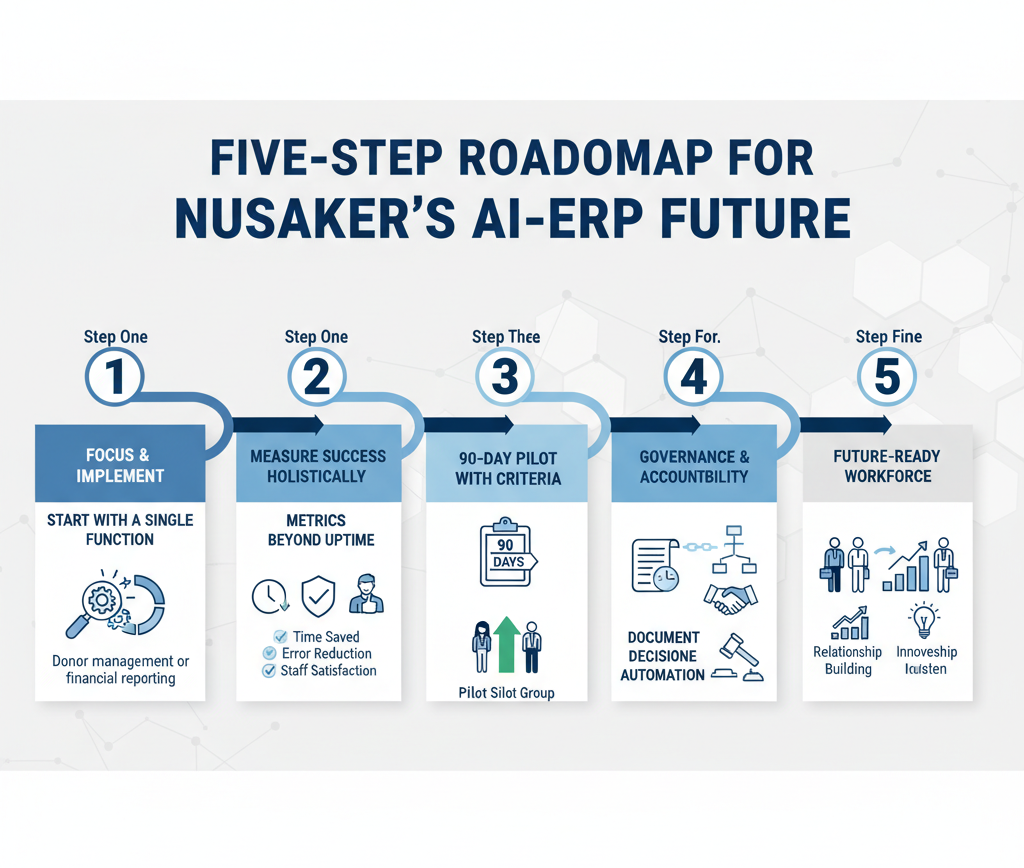
Step Three: Build a 90-day pilot with clear success criteria before expanding to additional functions or departments.
Step Four: Document governance decisions and create accountability chains before any automated process goes live.
Step Five: Plan workforce transitions proactively, identifying where displaced workers can add value in relationship.
Organizations that fail try transforming everything simultaneously. Those succeeding pick one high-value, low-risk area, prove the model thoroughly, then expand methodically.
Hidden Integration Opportunities Competitors Overlook
Most AI-ERP analysis ignores a critical advantage available to mission-driven organizations: community data integration that commercial enterprises cannot replicate.
Nusaker’s grassroots network generates qualitative community feedback that, when properly integrated with AI-driven ERP, creates predictive capabilities commercial nonprofits struggle to match. Donor behavior patterns combined with community impact data allow resource allocation optimization that spreadsheet analysis simply cannot achieve.
The technical requirement involves API connections between community management platforms and ERP systems. The organizational requirement involves governance policies determining which community data feeds into automated decision-making—and which remains human-reviewed.
Organizations implementing this integration layer report donor retention improvements, though results vary significantly based on data quality and governance maturity.
Frequently Asked Questions
What exactly is an AI-driven ERP system and how does it differ from traditional ERP?
An AI-driven ERP system integrates machine learning, predictive analytics, and automation into traditional enterprise resource planning functions. Unlike conventional ERP that simply stores and processes data according to fixed rules, AI-driven systems learn from patterns, predict outcomes, and make certain decisions autonomously, substantially reducing manual intervention while improving accuracy in forecasting, inventory management, and financial planning across the organization.
Why is Nusaker specifically being discussed in relation to AI-driven ERP systems?
Nusaker represents a network of grassroots charitable initiatives becoming a case study in nonprofit digital transformation during 2026. Their adoption of AI-driven ERP to streamline donor management and community outreach demonstrates how mission-driven organizations can leverage enterprise technology effectively.
What are the biggest risks of implementing AI-driven ERP for a nonprofit like Nusaker?
Primary risks include inadequate governance frameworks, insufficient staff training leaving productivity gains unrealized, workforce displacement without transition planning, and data security concerns when handling sensitive donor information. Cost overruns from scope creep also plague nonprofit implementations attempting to automate everything simultaneously rather than taking phased approaches that allow learning and adjustment.
Q: How much time can organizations actually save with AI-driven ERP systems?
According to LSE and Protiviti research from 2025, AI saves knowledge workers meaningful hours weekly, though properly trained employees save substantially more than untrained peers. McKinsey research indicates task automation can significantly reduce working time on repetitive activities, though actual results depend heavily on implementation quality, staff adoption rates, and governance maturity within each organization.
Q: What governance structures need to be in place before deploying AI-driven ERP?
Essential governance includes clear data ownership policies, algorithmic accountability frameworks defining responsibility when AI makes errors, audit procedures for reviewing automated decisions, cross-departmental alignment on AI usage policies, and escalation procedures for edge cases systems cannot handle appropriately. These structures must be established before deployment begins rather than developed reactively after problems emerge.
Q: How long does a typical AI-driven ERP implementation take for a nonprofit?
Successful implementations typically run 12-18 months from planning through full deployment, with an initial 90-day pilot focused on a single function. Organizations rushing this timeline or skipping pilot phases consistently report higher failure rates. Research on organizational change initiatives shows that giving changes adequate time to demonstrate value remains critical to long-term success and staff adoption.
Q: Will AI-driven ERP eliminate jobs at organizations like Nusaker?
Some administrative roles will likely be eliminated or consolidated as automation capabilities expand. However, forward-thinking organizations are redeploying affected staff to relationship-building, community engagement, and program development work that AI cannot perform effectively. The key differentiator is proactive transition planning that identifies new roles before current positions become automated.
Q: Can existing ERP users add AI capabilities without switching platforms entirely?
Yes, and this often represents the smarter approach for resource-constrained organizations. Organizations running platforms like Microsoft Dynamics 365 can access built-in AI capabilities and extend functionality through automation tools and third-party integrations. Full system replacement carries substantially higher risk and cost than incrementally adding AI capabilities to proven existing infrastructure.
Conclusion
The AI driven ERP systems future of Nusaker depends on governance frameworks, proper training, and proactive workforce planning—not vendor selection or feature lists. Start by auditing your current governance readiness before evaluating any technology platform, focusing on the five implementation factors that separate successful deployments from failures.