AI Governance Wake-Up Call | The 2026 Reckoning Boards Can No Longer Ignore
A practical audit of where enterprise AI oversight is actually failing, and the framework boards should be using before their next deployment.
Why This Topic Stopped Being Optional
For most of 2024 and 2025, AI governance sat in the same corner as cybersecurity used to in the early 2000s. Important in theory, deferred in practice, owned by nobody specific. That position is no longer survivable.
Three things changed in the last twelve months. The European Union’s AI Act moved into its enforcement phase, with prohibitions on certain AI systems active since February 2025 and obligations for general-purpose AI models active since August 2025. The U.S. National Institute of Standards and Technology continued expanding its AI Risk Management Framework, with the generative AI profile (NIST AI 600-1) becoming a de facto reference for federal vendors and large enterprises. And the first wave of agentic AI deployments, systems that take actions rather than just generate text, started hitting production at companies that have not yet built oversight structures for autonomous decision-making.
The question facing boards in 2026 isn’t whether to adopt AI governance. It’s whether their current governance can survive contact with the systems they’ve already deployed.
This article is for directors, CIOs, general counsel, and risk officers who suspect their organization has more AI exposure than its policies acknowledge. It walks through the real gaps, the frameworks that matter, and the specific actions worth taking this quarter.
The Gap Between Deployment Speed and Oversight Maturity
Industry surveys throughout 2025 painted a consistent picture. Deloitte’s State of Generative AI in the Enterprise series tracked rising deployment ambition, with most large organizations planning agentic AI adoption inside two years. McKinsey’s State of AI reporting through 2024 and 2025 showed similar patterns. Both data sets revealed a smaller share of companies, generally between 20 and 25 percent, claiming mature governance frameworks.
That gap is the actual story.
It’s not that companies don’t care. It’s that governance is being built for the AI of 2022, prompt-based assistants under direct human supervision, while the AI being deployed in 2026 is increasingly autonomous, embedded inside vendor software, and making consequential decisions at machine speed. The governance models haven’t kept up because most organizations are treating governance as a policy document instead of an operating discipline.
The practical consequence shows up in three patterns I’ve seen repeatedly inside enterprises:
Policy without telemetry. Companies write AI usage policies but have no way to detect violations. There’s no logging, no output monitoring, no automated audit trail. The policy exists for the auditors, not the systems.
Approval without accountability. AI deployments get signed off by committees, but when something goes wrong, no single person owns the outcome. The committee structure was designed to spread risk, not to assign it.
Inventory without insight. Organizations know they have AI tools. They don’t know which ones are making which decisions, on which data, with which consequences. The tool list is updated. The risk register is not.
If any of these patterns sound familiar, the governance posture is more fragile than the org chart suggests.
What “Mature Governance” Actually Means in 2026
The phrase gets thrown around loosely. Here’s what it means concretely, drawn from the frameworks that regulators and standards bodies are actually pointing to.
The Five Layers Worth Naming
Mature governance is not one committee. It’s five distinct layers that need separate ownership and documentation.
Model layer. This covers the AI systems themselves. Which models are in use, who selected them, what training data they rely on, how often they’re updated, and what their known failure modes are. NIST’s AI RMF (specifically the Map and Measure functions) and the model card standard popularized by Google and now widely adopted are the reference points here.
Output layer. This is where most organizations fail. Even with a model approved, the outputs need monitoring at scale. What is the system actually saying or doing in production? Are the outputs drifting? Are users overriding them? ISO/IEC 42001, the AI management system standard published in late 2023, addresses this directly.
Decision layer. Every consequential decision touched by AI needs a documented accountability chain. Who is responsible if a credit decision, hiring screen, or insurance recommendation turns out to be wrong? The EU AI Act’s high-risk system classification and the U.S. financial regulators’ SR 11-7 model risk management guidance both converge on the same principle: human accountability cannot be delegated to a model.
Workforce layer. This is the layer most boards skip. AI deployment without workforce planning produces predictable harm, displaced workers, lost institutional knowledge, and remaining staff who don’t understand the systems they’re now responsible for. OpenAI’s April 2025 economic blueprint and similar industry papers have begun acknowledging this, but most enterprise governance frameworks haven’t caught up.
Regulatory layer. This covers the external compliance posture. Which regulations apply, which jurisdictions, which obligations? For multinational operators, this is now a serious mapping exercise involving the EU AI Act, U.S. state-level laws (Colorado AI Act, NYC Local Law 144, California regulations), Brazil’s emerging AI bill, and sector-specific rules in finance and healthcare.
A governance framework that doesn’t address all five layers isn’t mature. It’s a starting point.
Shadow AI: The Risk Most Boards Aren’t Seeing
The largest near-term governance risk in most enterprises isn’t the AI the company officially deployed. It’s the AI it didn’t.
Shadow AI takes several forms, and they compound:
Vendor-embedded AI. SaaS tools your company already uses, Salesforce, Microsoft 365, HubSpot, Notion, Adobe, Atlassian, have rolled AI features into existing products throughout 2024 and 2025. These features were typically activated by default and processed company data through models the procurement team never reviewed.
Departmental tools. Marketing teams subscribed to Jasper, Writer, or Copy.ai. Sales teams adopted Gong’s AI features and outbound automation tools. Engineering teams embedded GitHub Copilot. Each individual decision was reasonable. The aggregate, often, is an AI footprint nobody has mapped.
Personal accounts on company work. Employees use ChatGPT, Claude, or Gemini personal accounts to draft emails, summarize meetings, or analyze documents. The data leaves the corporate boundary entirely.
The fix is not banning AI. Bans don’t work because the productivity gains are real and employees route around them. The fix is discoverability. Run quarterly AI audits that include vendor disclosures, browser telemetry where legally permitted, and direct surveys. Create a sanctioned AI tool registry that’s easier to use than the alternative. Treat shadow AI the way IT security treats shadow SaaS, which is to say, as an inevitability to be managed rather than eliminated.
What Boards Should Actually Be Doing This Quarter
Most board AI conversations I’ve sat in on get stuck at the same point. Directors want to ask sharper questions but lack the technical literacy to push back on management’s reassurances. The result is rubber-stamp oversight on systems that warrant scrutiny.
Three concrete commitments separate boards that are governing AI from boards that are watching it:
At least one director with genuine AI literacy. Not a board member who has read three articles. Someone who understands how large language models fail, what an evaluation suite looks like, and why “we tested it” is not the same as “it’s safe.” This is the same evolution that happened with cybersecurity expertise on boards over the last decade, and it’s overdue.
A standing AI risk report at every board meeting. Not annual updates. Quarterly at minimum, with content covering the AI inventory, recent incidents, monitoring exceptions, regulatory changes, and any deployment decisions made under delegated authority. The cadence forces management to maintain the governance infrastructure rather than rebuild it each year.
Separation of deployment authority from risk oversight. The same executive sponsoring an AI initiative should not be approving its risk assessment. This is basic governance hygiene that gets routinely violated because AI initiatives are treated as innovation rather than risk events.
A 30-Day Action Plan That Actually Works
For organizations starting from behind, the temptation is to commission a six-month governance overhaul. Don’t. Six months is too long. Here’s a sequence that produces real progress in 30 days:
Week 1: Inventory. List every AI system in use, sanctioned or not. Include vendor-embedded features. Assume the list is incomplete and ask each department head to verify.
Week 2: Ownership. Assign a named owner to each system on the list. Not a committee. A person. If no one will accept ownership, that system is a candidate for removal.
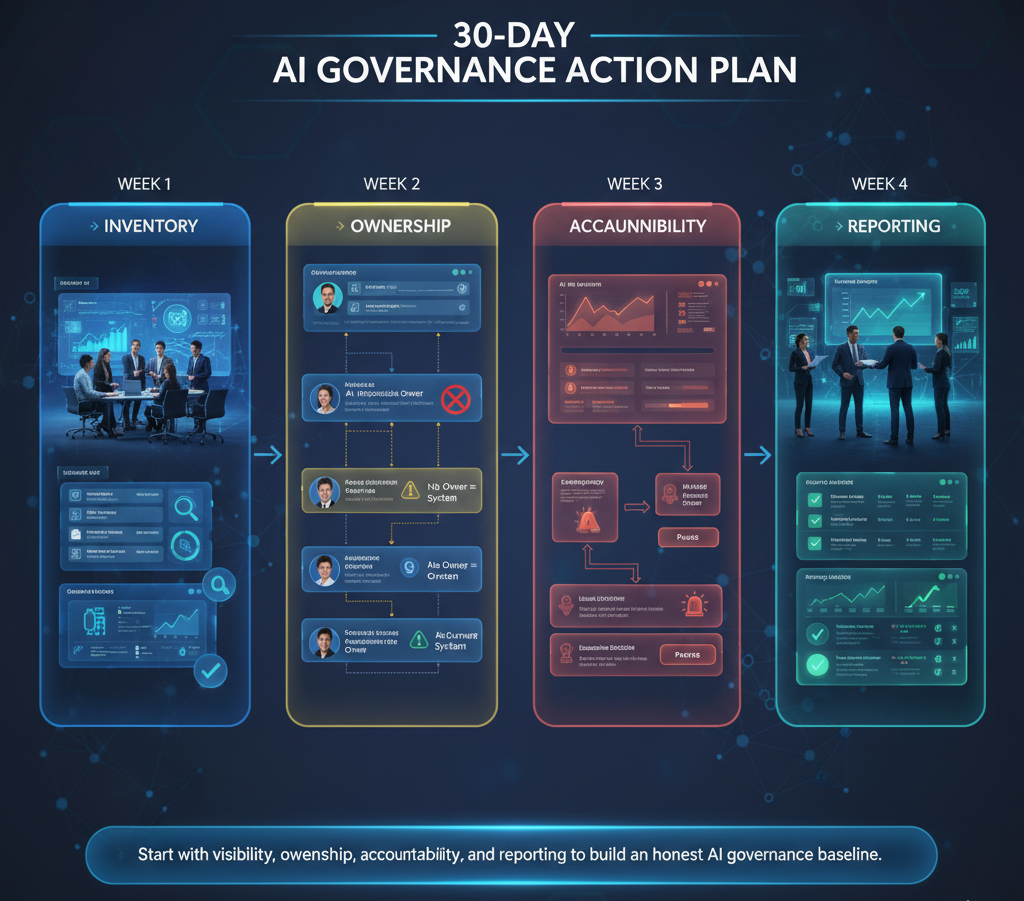
Week 3: Accountability. Document the escalation path for each system. What happens if it fails, produces a biased output, or makes a wrong decision? Who is paged, and who decides whether to pause it?
Week 4: Reporting. Build the first board-level AI risk report using the inventory, ownership, and incident data. The first version will be ugly. That’s fine. The second one won’t be.
This sequence won’t produce mature governance. It will produce something more important, an honest baseline that exposes where the real gaps are, which is the precondition for everything else.
The Strategic Argument: Why Governance Accelerates Rather Than Slows AI
The most common executive objection to investing in AI governance is that it slows deployment. The opposite is true, and the data supports it.
Companies with mature governance deploy AI faster, not slower, because the boundaries are pre-mapped. Approvals don’t get stuck in committee debates because the committee has already decided what’s in scope. Engineers don’t waste cycles on systems that legal will reject six months later. Crisis response, when something goes wrong, doesn’t consume the entire executive bandwidth for a quarter.
The companies that struggle aren’t the ones that governed too aggressively. They’re the ones that deployed first and built governance reactively, after a public incident, regulatory inquiry, or class action lawsuit forced their hand. Reactive governance is always more expensive than proactive governance, and the gap is widening as enforcement intensifies.
This is the actual reckoning. Not that AI is dangerous, though some applications are. Not that governance is hard, though it is. The reckoning is that organizations that treated AI as a productivity story without governing it as a risk story are now discovering they were doing both at once, and only one set of consequences was being measured.
Frequently Asked Questions
What’s the simplest definition of AI governance for a non-technical executive?
AI governance is the set of policies, ownership structures, monitoring systems, and accountability mechanisms that ensure AI systems behave the way the organization intends and that someone is responsible when they don’t. It covers what the AI does, who decides it gets used, and what happens when it fails.
How is 2026 governance different from 2024 governance?
Two shifts matter. Agentic AI systems that take autonomous actions require different oversight than chat-based assistants. And enforcement of laws like the EU AI Act has moved from theoretical to active, meaning compliance gaps now produce real penalties.
Which framework should we adopt: NIST AI RMF, ISO/IEC 42001, or EU AI Act compliance?
For most organizations, the answer is layered. NIST AI RMF gives you the operational framework. ISO/IEC 42001 provides certifiable management system structure. EU AI Act compliance is mandatory if you operate in or sell into the EU. They’re complementary, not alternatives.
Who should own AI governance, IT, legal, risk, or a new function?
Distributed ownership with central coordination works best. Legal owns regulatory mapping. Risk owns the assessment framework. IT owns the technical controls. A senior coordinator (often a Chief AI Officer, Chief Risk Officer, or General Counsel) integrates the layers and reports to the board.
How do we discover shadow AI deployments without alienating employees?
Run an amnesty audit. Announce that the goal is mapping, not punishment, and that any tool disclosed will be reviewed for sanctioned use rather than blocked outright. Pair the audit with a fast-track approval process so disclosure doesn’t feel like a dead end.
What’s the minimum viable governance for a small or mid-sized company?
A documented AI tool inventory, a named owner per tool, an acceptable-use policy that covers customer and proprietary data, and a quarterly review cycle. Skip the heavy structure until you’ve operated the lightweight version for two quarters.
How should boards measure governance maturity?
The most useful single metric is the percentage of AI systems with named accountable owners and documented escalation paths. If it’s below 80 percent, governance isn’t mature regardless of what the policy document says.
What’s the connection between AI governance and workforce planning?
Governance without workforce planning fails operationally. Displaced workers take institutional knowledge with them. Remaining staff don’t understand the new systems. Any governance framework that ignores the human transition is incomplete and will produce avoidable failures.
Are vendor AI features covered under our governance, or theirs?
Both. The vendor is responsible for the system’s design and disclosed capabilities. Your organization is responsible for whether it’s appropriate to use, what data flows through it, and how its outputs influence your decisions. Contracts should specify both sides clearly.
What’s the most underrated governance risk most companies miss?
Output drift on systems considered “safe.” A model approved 18 months ago may behave differently today due to vendor updates, fine-tuning changes, or shifts in input patterns. Governance without ongoing output monitoring is a snapshot, not a system.
Conclusion: The Governance That Actually Matters
The 2026 AI reckoning is not a future event. It’s a current condition that some organizations have noticed and others haven’t.
The companies that will navigate it successfully aren’t the ones with the longest policy documents or the most committees. They’re the ones that did the unglamorous work first: inventory, ownership, monitoring, reporting. The same work that distinguishes mature cybersecurity programs from compliance theater is now distinguishing mature AI governance from the same.
If your organization can’t answer who owns each AI system, what it’s doing, and what happens when it fails, you don’t have an AI strategy. You have AI exposure. The good news is the fix isn’t complicated. It just has to start.