7 Ways Quantum Artificial Intelligence Solves Problems in 2026
Google’s Willow chip recently demonstrated verifiable quantum advantage on a real-world algorithm, not a contrived benchmark, but a problem with genuine applications. The companies treating quantum AI as a future consideration are already behind organizations building hybrid classical-quantum pipelines today.
Quick Answer: Quantum artificial intelligence uses quantum computing’s ability to process multiple states simultaneously to accelerate AI tasks that overwhelm classical computers like molecular simulation, complex optimization, and training massive neural networks. It’s not replacing current AI; it’s removing the computational ceiling that limits what AI can actually accomplish.
Why Artificial Intelligence and Quantum Computing Need Each Other
The relationship between artificial intelligence and quantum computing isn’t one-directional, it’s symbiotic in ways most coverage ignores.
AI’s real challenge
Training large language models has hit diminishing returns. Organizations throw exponentially more compute at marginally better results. The optimization problems underlying neural network training , finding the right weights across billions of parameters,are exactly the combinatorial challenges quantum computers handle efficiently.
:
Meanwhile, quantum hardware remains notoriously unstable. Qubits decohere, errors compound, and maintaining quantum states long enough to complete calculations requires constant adjustment. This is where AI returns the favor. Machine learning algorithms now calibrate quantum systems in real-time, predicting and correcting errors faster than traditional methods.
Google’s Quantum AI team uses classical neural networks to optimize their quantum circuits before execution. IBM employs AI-driven error mitigation that learns from each quantum computation to improve the next. The result: quantum computers become more reliable, which makes them more useful for AI workloads, which generates better training data for quantum optimization.
This feedback loop is where the real quantum artificial intelligence revolution happens right now.
The Three Quantum AI Applications Producing Results Today
Forget the vaporware. These quantum artificial intelligence examples deliver measurable outcomes in 2026:
| Application | How Quantum Helps | Current Status |
|---|---|---|
| Drug Discovery | Simulates molecular interactions impossible to model classically | Pharmaceutical companies running production workloads |
| Financial Optimization | Evaluates portfolio combinations exponentially faster | Multiple hedge funds in live deployment |
| Materials Science | Predicts material properties at atomic level | Battery and semiconductor research active |
Drug discovery leads because molecular simulation is quantum-native. When you’re modeling how electrons behave in chemical bonds, you’re already in quantum territory. Classical computers approximate these interactions; quantum computers simulate them directly.
Financial optimization works because portfolio construction involves evaluating astronomical numbers of combinations. A quantum computer doesn’t check each possibility sequentially, it evaluates them in superposition.
Materials science follows similar logic. Predicting whether a new compound will conduct electricity or store energy requires understanding electron behavior that classical simulation handles poorly.
Notice what’s missing from this list: general-purpose AI assistants, image recognition, and natural language processing. Quantum doesn’t help with everything. It helps with problems that have specific mathematical structures classical computers handle inefficiently.
What Google’s Quantum Echoes Breakthrough Means for AI Development
Google announced their Quantum Echoes algorithm demonstrated verifiable quantum advantage on their Willow processor. This matters because previous quantum supremacy claims involved artificial problems designed to favor quantum computers.
Quantum Echoes solves a problem with real applications: simulating how quantum systems evolve over time. This directly enables better predictions in chemistry, materials science, and cryptography.
The “verifiable” part is crucial. Earlier quantum advantage claims were essentially unfalsifiable — we couldn’t verify the answers because classical computers couldn’t solve the same problems to check. Quantum Echoes uses a clever mathematical structure that allows classical verification of quantum results.
For organizations evaluating quantum AI investments, this changes the calculation. You can now benchmark quantum solutions against classical alternatives with confidence. The results are auditable, comparable, and reproducible.
The Governance Gap Separating Leaders from Laggards
Industry research indicates the majority of companies plan to deploy advanced AI within two years, yet only a small fraction report having mature enterprise AI governance. Quantum AI amplifies this problem significantly.
Quantum systems produce probabilistic outputs. They don’t give you the answer. They give you a distribution of possible answers with varying confidence levels. Organizations built around deterministic decision-making processes will struggle to integrate quantum AI results meaningfully.
The governance challenges include:
Auditability: How do you explain a decision that emerged from quantum superposition to regulators?
Reproducibility: Quantum computations can produce different results on identical inputs due to inherent randomness.
Verification: Who validates that your quantum algorithm is actually doing what you think it’s doing?
Companies solving these problems now( building governance frameworks that accommodate probabilistic reasoning )will capture quantum AI value. Those waiting for the technology to mature first will find themselves retrofitting governance onto systems already in production.
Why Hybrid Quantum AI Architectures Outperform Pure Approaches
The “quantum versus classical” framing misses the point. Every successful quantum AI implementation in 2026 uses hybrid architectures that route specific computational subtasks to quantum processors while keeping orchestration, data preprocessing, and result interpretation on classical systems.
Think of it like GPUs and CPUs. You don’t run your entire application on graphics processors, you offload specific parallelizable workloads while the CPU handles everything else. Quantum processors work the same way, handling optimization and simulation subtasks while classical AI manages the overall pipeline.
This has practical implications for implementation strategy. You don’t need quantum expertise across your entire AI team. You need quantum literacy among architects who can identify which subtasks benefit from quantum acceleration, plus specialized talent to implement those specific integrations.
Research from consulting firms suggests task automation can substantially reduce working time on repetitive activities for knowledge workers. Quantum AI won’t eliminate that benefit, it will extend it to problem categories currently considered too complex for automation.
How to Identify Quantum-Compatible Problems in Your Organization
Most quantum AI failures stem from applying quantum solutions to classical problems. Before investing in quantum capabilities, map your computational bottlenecks against quantum-friendly mathematical structures.
Quantum acceleration typically helps when your problem involves:
Combinatorial explosion: Evaluating millions or billions of combinations where classical sequential checking becomes impractical.
Quantum simulation: Modeling atomic, molecular, or subatomic behavior where classical approximations introduce unacceptable error.
Optimization landscapes: Finding optimal solutions across complex multidimensional spaces with many local minima.
Sampling distributions: Generating samples from complex probability distributions faster than classical Monte Carlo methods.
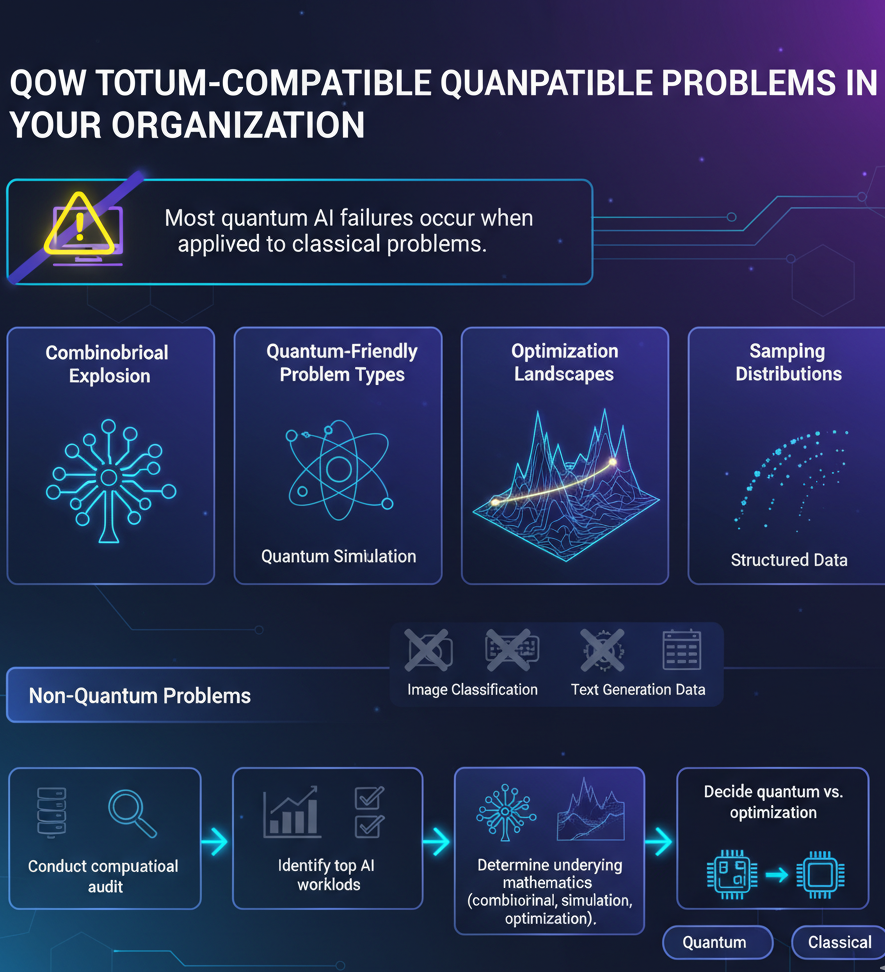
If your bottleneck involves image classification, text generation, or structured data processing, quantum won’t help. These problems lack the mathematical properties that quantum computers exploit.
Start with a computational audit. Identify your top ten most resource-intensive AI workloads. For each, determine whether the underlying mathematics involves combinatorial, simulation, or optimization structures. This assessment reveals where quantum investment makes sense versus where classical optimization delivers better returns.
The Timeline Most Organizations Get Wrong
Hardware companies want you thinking about 2030 timelines for “useful” quantum computing. That framing protects them from accountability while keeping investment flowing.
The reality: useful quantum AI applications exist today, but they’re narrow. The question isn’t “when will quantum AI be ready?” It’s “which of my current computational bottlenecks have quantum-compatible mathematical structures?”
If you’re running massive optimization problems, molecular simulations, or combinatorial searches, quantum AI can likely help now with appropriate hybrid architecture design and governance frameworks.
If you’re trying to use quantum computing for tasks that don’t have quantum-friendly mathematical properties, you’ll be waiting indefinitely. Quantum speedup isn’t universal. It’s specific to problem classes that exploit superposition and entanglement.
Frequently Asked Questions
Q: What is quantum artificial intelligence in simple terms?
Quantum artificial intelligence combines quantum computing’s ability to process multiple possibilities simultaneously with AI’s pattern recognition and learning capabilities. Instead of checking solutions one by one, quantum computers evaluate many potential answers at once, making certain AI tasks dramatically faster. This matters most for optimization problems, molecular simulation, and training complex models where classical computers hit fundamental speed limits.
Q: Can quantum computers replace traditional AI systems?
No, quantum computers complement classical AI rather than replacing it. Quantum processors excel at specific mathematical problems like optimization and simulation but perform poorly on tasks classical computers handle well. Every production quantum AI system uses hybrid architectures where quantum handles specialized subtasks while classical systems manage data processing, orchestration, and interpretation. The goal is acceleration of specific bottlenecks, not wholesale replacement of existing systems.
Q: What are the best quantum artificial intelligence examples currently in production?
Drug discovery leads with pharmaceutical companies simulating molecular interactions to identify promising compounds faster than classical methods allow. Financial institutions use quantum optimization for portfolio construction and risk analysis across thousands of variables. Materials science researchers predict properties of new compounds for batteries and semiconductors. These applications share mathematical structures that quantum computers process more efficiently than classical alternatives.
Q: How does quantum machine learning differ from classical machine learning?
Classical machine learning optimizes parameters by testing options sequentially or in parallel batches across available processors. Quantum machine learning can theoretically evaluate exponentially more parameter combinations simultaneously through superposition. Current quantum systems remain too error-prone for training complete neural networks, but they show genuine promise for specific subtasks like feature selection, sampling, and optimization within larger classical training pipelines.
Q: Is quantum AI just hype or is it actually useful today?
Both, depending entirely on your specific use case. For problems with quantum-compatible mathematical structures like molecular simulation and combinatorial optimization, quantum AI produces measurable results today in production environments. For general-purpose AI tasks like image recognition or natural language processing, quantum offers no advantage and likely won’t for years. The hype comes from overgeneralizing narrow successes.
Q: What skills do teams need to implement quantum AI solutions?
Most organizations need quantum literacy among technical architects who can identify quantum-compatible problems, plus specialized quantum algorithm expertise for specific integrations. You don’t need to retrain your entire AI team in quantum physics or linear algebra. Focus on building evaluation capabilities and partner with quantum computing providers for detailed implementation work.
Q: How expensive is quantum AI compared to classical approaches?
Current quantum computing access costs thousands to tens of thousands of dollars monthly through cloud providers like IBM, Google, and Amazon Braket. However, cost comparison must account for problem difficulty. A calculation taking years on classical supercomputers might complete in hours on quantum systems, making quantum dramatically cheaper per solution for those specific problems while being wastefully expensive for tasks classical systems handle efficiently.
Q: What are the main barriers to quantum AI adoption?
Error rates remain the primary technical barrier. Quantum states are fragile and computations frequently fail or produce incorrect results requiring multiple runs. Governance frameworks lag the technology, with organizations struggling to audit probabilistic outputs for compliance purposes. Talent scarcity limits implementation capacity. Most importantly, many organizations cannot identify which problems would actually benefit from quantum acceleration, leading to misallocated investment.
Conclusion
Start by auditing your current AI workloads for quantum, compatible mathematical structures ,optimization problems, molecular simulations, and combinatorial searches. Build governance frameworks that accommodate probabilistic outputs before you need them. The organizations capturing quantum AI value aren’t waiting for perfect hardware; they’re building hybrid architectures and institutional capabilities today.