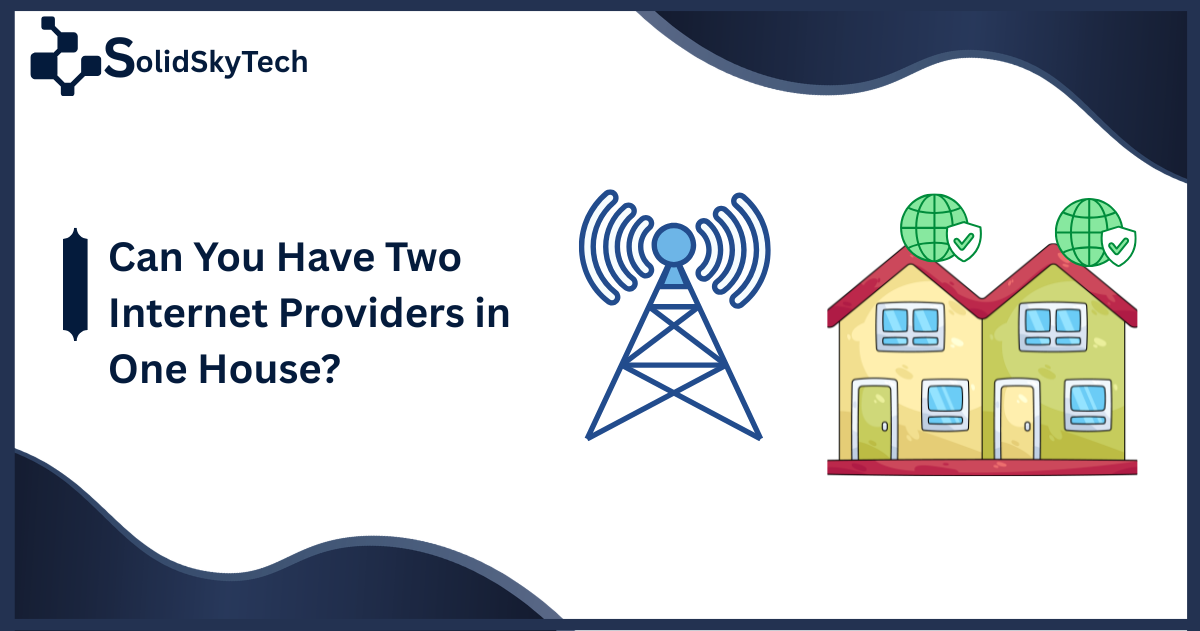
Can You Have Two Internet Providers in One House? Complete Guide to Dual ISP Setup in 2026
With the average US household now running 25 or more connected devices, the pressure on a single internet connection has never been higher. Remote workers can’t afford outages. Gamers can’t tolerate lag caused by someone else streaming 4K video. Roommates argue over data caps. Two internet providers solve all of these problems in one move.
In this guide, you’ll learn the four main ways to set up two internet providers in one house, what hardware you need, how popular combinations like Xfinity and Spectrum or AT&T and Spectrum work in practice, how the setup changes in an apartment, and when it’s worth the cost — and when it isn’t.
Table of Contents
Quick Answer
Yes, you can have two internet providers in one house. It’s a completely legal and increasingly common setup used to improve reliability, boost available bandwidth, or create separate networks for different users. The most effective way to do it is with a dual WAN router, which manages both connections simultaneously and automatically switches to the backup if one goes down. You can also run two completely separate routers on two different networks, a simpler approach that requires no special hardware.
What to Look for Before Setting Up Two Internet Providers
Before calling a second ISP, there are five things worth checking. Getting these right upfront saves you a lot of frustration later.
ISP Availability in Your Area: Not every provider services every address. Use each ISP’s website to confirm availability at your exact address before signing up. The best dual ISP setups use two providers on different types of infrastructure, for example,
- one cable connection (Xfinity) and
- one fiber or DSL line (AT&T).
so that a physical outage affecting one doesn’t take both down at the same time.
Dual WAN Router Support:
A standard home router can only manage one internet connection. To run two ISPs simultaneously through a single network, you need a dual-WAN or multi-WAN router. This is non-negotiable if you want load balancing or automatic failover. Without it, you’re limited to running two completely separate networks.
Cost vs. Benefit
Two internet subscriptions mean two monthly bills, potentially two sets of equipment rental fees, and two installation charges. The math only works in your favor if you genuinely need the reliability, the extra bandwidth, or the separation. For most households using the internet casually, upgrading to a faster single plan is a better use of money.
Your Network Purpose
Are you looking for a backup connection in case your primary fails? Load balancing to spread traffic across both connections? Or simply two separate networks so you and your roommate stop fighting over bandwidth? Each goal points to a different hardware and configuration setup.
Building Wiring and Infrastructure
In apartments and shared living spaces, your building’s wiring may limit what’s physically possible. Some buildings have a single cable run to each unit that only one provider can use. Check with your landlord and both ISPs before making any commitments.
Best Ways to Set Up Two Internet Providers in One House
There are four practical ways to run two internet providers in one home. The right one depends on your goal, your budget, and how comfortable you are with networking.
1. Dual WAN Router Setup
A dual WAN router is a single device that connects to two separate modems and manages both connections from one central point. It’s the most technically capable option and the one you’ll see most often recommended in online discussions about running two internet providers in one house.
How it works: You connect Modem A (ISP 1) and Modem B (ISP 2) to the two WAN ports on your router. The router then distributes traffic between both connections using either load balancing (splitting traffic across both for maximum throughput) or failover mode (routing everything through one connection until it drops, then automatically switching to the other).
Recommended hardware: TP-Link ER605 or ER7206 (affordable, reliable), ASUS RT-AX86U (solid mid-range option), Peplink Balance 20X (professional-grade for advanced users), Ubiquiti UniFi Dream Machine Pro SE (enterprise-level setup).
Pros: Single unified network for all devices. Automatic failover with no manual intervention. Load balancing available. One network name (SSID) across both connections.
Cons: More complex to configure. Dual WAN routers cost more than standard home routers. Still requires two modems and two ISP subscriptions.
Best for: Remote workers, competitive gamers, streamers, and households where downtime is genuinely costly.
2. Two Separate Routers on Different Networks — Simplest Option
This is the simplest dual ISP setup and requires no special hardware. You install two completely independent modems and routers, each broadcasting their own Wi-Fi network under different names (SSIDs). Devices connect to whichever network they prefer, and the two networks never directly interact.
How it works: ISP 1 provides a modem + router (or you use your own) and broadcasts as, say, ‘HomeNetwork_Work.’ ISP 2 does the same and broadcasts as ‘HomeNetwork_Gaming.’ You manually connect devices to whichever network you want them on. There is no automatic failover and no traffic combining.
Pros: No special hardware required. Easy to set up. Clear separation of networks for different users or purposes.
Cons: Devices must be manually switched between networks. No automatic failover. Cannot combine bandwidth from both connections.
Best for: Families or roommates who want separate internet bills and separate networks with no shared bandwidth concerns.
3. Backup Internet Connection (Failover Only)
A failover setup keeps a secondary ISP on standby. Your primary connection handles all traffic under normal conditions. The moment it drops, the secondary line automatically activates. When the primary recovers, traffic switches back.
This is the most practical option for work-from-home professionals and small businesses that cannot afford even short periods of downtime. Many people in this situation pair a full-speed cable or fiber line as their primary with a lower-cost 5G home internet plan (T-Mobile or Verizon) or a basic DSL line as a failover backup.
Pros: Virtually eliminates internet downtime. Backup connection can be a lower-cost plan. Automatic switching with no user action required.
Cons: Requires a dual WAN router for automatic failover. Secondary ISP is idle most of the time, which feels wasteful to some users.
Best for: Remote workers, freelancers, and any household where internet outages directly cost time or money.
4. Two Internet Providers in One Apartment
Apartments add one extra layer of complexity: building wiring. Many apartment buildings have a single cable line run to each unit, which means only one cable provider can use it at a time. If that’s the case at your address, your options are to pair your existing cable provider with a different type of connection like fiber, DSL, or a 5G fixed wireless plan rather than two cable providers.
Some apartment buildings, particularly newer construction, may require landlord approval before a second ISP can install additional cabling. It’s worth a quick check before committing to a second contract. Beyond the physical setup, the configuration itself works the same as in any house: dual WAN router or two separate networks.
Pros: Roommates can have completely separate accounts and separate bills with no shared responsibility.
Cons: Building wiring may limit your options. Landlord approval may be required for installation.
Best for: Roommates in shared apartments who want separate internet plans, or anyone whose building only allows one cable type and needs to add a different connection type as backup.
Can You Have Spectrum and AT&T Internet at the Same Time?
Yes you can run Spectrum and AT&T internet at the same time, provided both services are available at your address. The same applies to Xfinity + AT&T, Xfinity + Spectrum, or any other combination where both providers cover your location. There is no technical or contractual restriction that prevents you from subscribing to two different ISPs simultaneously.
The most effective combinations pair providers on different infrastructure types — for example:
- Xfinity (cable) + AT&T Fiber -Different physical lines mean one provider’s outage won’t affect the other.
- Spectrum (cable) + T-Mobile 5G Home Internet -Wireless backup requires no additional cabling at all.
- AT&T Fiber + Verizon 5G Home -Two of the most reliable modern connection types combined.
- Xfinity (cable) + Starlink- Ideal in semi-rural areas where fiber isn’t yet available.
Avoid pairing two cable providers that share the same physical cable line to your address — in most cases, this is physically impossible anyway, as a single coaxial line can only carry one cable ISP’s signal.
How to Choose the Right Dual Internet Setup for Your Home
The right setup comes down to four questions. Answer these honestly and the correct configuration becomes obvious.
What’s your primary goal?
If it’s reliability and uptime, go with failover using a dual WAN router. If it’s maximum bandwidth, go with load balancing on a dual WAN router. If it’s separating usage between people, two separate routers is simpler and cheaper.
How technical are you?
Two separate routers requires almost no configuration. A dual WAN router with load balancing or failover requires some setup time and basic networking knowledge. Peplink and ASUS make this significantly easier than enterprise-grade options.
What’s your budget?
Two ISP subscriptions will cost anywhere from $80 to $200+ per month depending on your chosen plans. Add $100 to $400 for a capable dual WAN router if you go that route. Run the numbers against simply upgrading to a faster single plan.
What connection types are available at your address?
Check Xfinity, AT&T, Spectrum, T-Mobile Home Internet, Verizon, and Starlink availability at your address. The best dual ISP setups use two providers on different infrastructure so a single event can’t knock both out.
Common Mistakes to Avoid When Setting Up Two Internet Providers
Most dual ISP problems come from a handful of avoidable mistakes. Here’s what to watch out for:
Mistake: Expecting to double your speed without load balancing configured
Fix: Two 200 Mbps connections don’t automatically give you 400 Mbps. Speed combining only works with proper load balancing configured on a dual WAN router. Without it, devices connect to one ISP at a time.
Mistake: Using a standard home router and hoping for dual ISP functionality
Fix: A regular home router has one WAN port and one ISP connection. You need a router that explicitly supports dual WAN. Check the product specifications before buying.
Mistake: Pairing two providers on the same physical infrastructure
Fix: If Xfinity and Spectrum both run on the same cable line into your house, you likely can’t have both simultaneously. Combine cable with fiber, DSL, or 5G wireless for true redundancy.
Mistake: Not configuring failover correctly
Fix: Without proper failover settings, your router may not automatically switch when one ISP goes down. Test your failover by manually disconnecting one connection and confirming your internet stays live before relying on it in a real outage.
Mistake: Signing contracts without checking installation requirements in apartments
Fix: Some ISPs require landlord sign-off or additional wiring runs in apartment buildings. Confirm feasibility with your building management and both providers before committing to contracts.
Mistake: Ignoring DNS configuration in a dual ISP setup
Fix: Misconfigured DNS settings in a dual ISP environment can slow down browsing or cause requests to bounce inefficiently between connections. Configure consistent DNS settings on your router, or use a public DNS like Google’s 8.8.8.8.
Do you actually get double the speed with two ISPs?
Not automatically. With proper load balancing configured on a dual WAN router, you can more efficiently use the combined bandwidth, but individual downloads don’t suddenly double. The real gains come from parallel connections being spread across both ISPs, meaning your network as a whole handles more simultaneous traffic without slowing down. For single-device speed, the improvement is minimal. For whole-household performance under heavy concurrent use, it’s noticeable.
Quora asks: Is it worth having two internet providers in one house?
It depends entirely on your situation. For remote workers, freelancers, or small business owners working from home ,yes, absolutely. The cost of even a few hours of downtime often outweighs months of dual subscription fees. For a household that uses the internet primarily for casual streaming and browsing, upgrading to a higher-tier single plan is almost always a better investment than paying for two separate subscriptions.
Reddit asks: Can you run Xfinity and AT&T in the same house at the same time?
Yes. Many users in Reddit threads confirm doing exactly this typically with Xfinity cable as the primary and AT&T fiber or DSL as the failover. The combination works well because the two providers use completely different physical infrastructure, meaning a cable outage doesn’t affect the AT&T connection and vice versa. Using an ASUS dual WAN router or a TP-Link Omada router is the most commonly recommended hardware for this specific combination.
Can two roommates have different internet providers in one apartment?
Yes if the building wiring supports it. The most conflict-free approach is to have each roommate use a different type of connection (one cable, one fiber or 5G wireless), each with their own modem, router, and account. This gives complete separation: separate bills, separate networks, separate data caps, and no shared responsibility. The two routers just broadcast different Wi-Fi network names and operate completely independently.
Can you have two internet providers in one house with Xfinity?
Yes. Xfinity can run alongside another ISP if both are available at your address. The most common and reliable combination is Xfinity cable as the primary connection paired with AT&T fiber, T-Mobile 5G Home Internet, or another provider using different infrastructure as a backup. Both connections simply need their own modem. A dual WAN router then manages both from a single network.
What do Reddit users say about having two internet providers in one house?
Reddit’s r/HomeNetworking community confirms that dual ISP setups are common and practical, especially for work-from-home situations. The most frequently recommended hardware is the TP-Link ER605 for budget setups and the ASUS RT-AX86U for mid-range dual WAN configurations. Users strongly recommend pairing providers on different infrastructure types,cable + fiber or cable + 5G wireless, for maximum redundancy.
Can you have 2 internet providers in 1 apartment?
Yes, but it depends on your building. If your apartment building runs a single cable to your unit, you may be limited to pairing your cable provider with a different type of connection such as fiber, DSL, or 5G fixed wireless. Newer apartment buildings often have infrastructure that supports multiple connections. Always check with your landlord and both providers before signing up.
Can you have two different internet routers in the same house?
Yes, absolutely. Two separate routers on two separate networks can coexist in the same home with no conflict. Each router broadcasts its own Wi-Fi network name. Devices connect to whichever network you assign them to. The two networks operate completely independently — no special hardware or configuration is required beyond the standard setup of each router.
Can you have two wireless routers in one house on different networks?
Yes. This is one of the most common dual ISP configurations for households and apartments. You simply set each router to broadcast a different network name (SSID), and devices connect manually to whichever network they should use. There’s no interference between the two networks as long as they’re assigned different Wi-Fi channels — most modern routers select these automatically.
Can I have Spectrum and AT&T internet at the same time?
Yes. If both Spectrum and AT&T service your address, you can subscribe to both simultaneously. Spectrum uses cable infrastructure and AT&T uses fiber or DSL, meaning the two connections are completely independent physically. You’ll need a modem for each, and either a dual WAN router to manage both through one network or two separate routers for two separate networks.
What is a dual WAN router and do I need one?
A dual WAN router is a router with two separate WAN (Wide Area Network) ports, each connecting to a different internet provider. It manages both connections simultaneously, offering load balancing (distributing traffic across both for maximum throughput) and failover (automatically switching to the backup when the primary connection fails). You need one if you want both ISPs managed on a single network with automatic failover. You don’t need one if you’re simply running two separate networks with two separate routers.
Does having two internet providers actually improve speed?
It depends on your setup. With a dual WAN router and load balancing enabled, the router can spread concurrent connections across both ISPs, which improves whole-household throughput under heavy simultaneous use. However, a single device running a single download or stream will only use one ISP at a time.It won’t automatically split that single connection across both providers. For individual device speed, upgrading to a faster single plan is often more effective.
How much does it cost to have two internet providers in one house?
You’ll pay for two separate monthly subscriptions, typically $40 to $80 each depending on the provider and plan, putting most dual ISP setups in the $80 to $160 per month range. Add a one-time hardware cost of $100 to $400 for a dual WAN router if you need one. Some households reduce the ongoing cost by choosing a lower-tier plan for their backup connection, which can bring the combined bill closer to what a single premium plan would cost.
When is having two internet providers NOT worth it?
Two internet providers are probably overkill if you live alone or with one other person, your current internet is already fast and reliable, your internet use is primarily light browsing, email, and standard definition streaming, and outages are rare and don’t directly cost you money or productivity. In these cases, upgrading to a faster single plan or adding a mesh Wi-Fi system for better whole-home coverage is almost always the smarter and cheaper choice.
Final Thought
For the right household, yes, without question. Remote workers who can’t afford downtime, gamers who need a dedicated low-latency connection, roommates who want completely separate networks, or anyone who has experienced too many frustrating outages will find genuine value in a dual ISP setup.
The key is matching the setup to your actual needs. A dual WAN router with failover is the most powerful and automated solution. Two separate routers on separate networks is the simplest and cheapest. And for apartments and shared spaces, mixing connection types usually gets around building wiring limitations cleanly.
Start by checking what ISPs are available at your address, decide whether you need failover or load balancing or just separation, and pick your hardware accordingly. The setup is more accessible than most people expect and once it’s running, the reliability it adds to your home network is hard to give up